
Nineteen Years of Asking Why People Buy
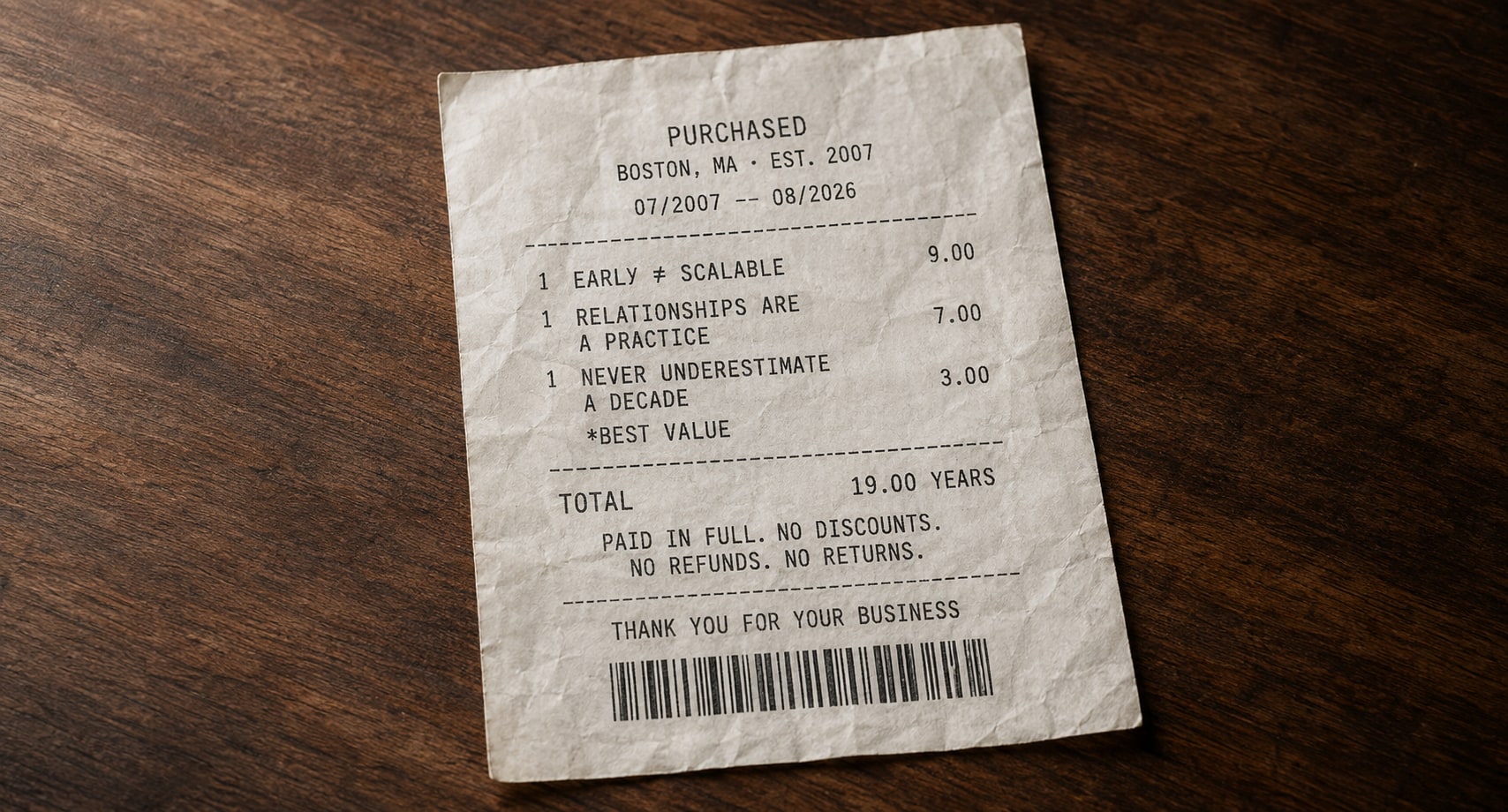
In 2007, while still a tenure-track faculty member at Northeastern, I founded a company. A few months later our daughter was born. The company and our daughter are the same age. I kept teaching for two more years while building the company, and I don’t think either one suffered for it — but it was overwhelming, and eventually I had to choose.
I was a communication studies professor doing conversation analysis, which meant I spent my time studying how people actually talk, turn by turn, in everyday life and in business settings. What kept surfacing in the transcripts was how much of ordinary conversation is about brands. People recommend, complain, warn, show off. None of it is marketing. It is just how we talk about our lives, and brands are in our lives.
So I went to a Boston agency with a question: could we compare everyday recommendation against conversation a campaign had deliberately sought to inspire? That became a six-figure academic-industry grant, a peer-reviewed paper, and G2X — one of the first independently validated methodologies for measuring word-of-mouth ROI. I negotiated a technology-transfer agreement with the university and founded ChatThreads to take it to market.
Then I was wrong about the thing I was most certain of. Brands did not care about word of mouth. They cared whether people bought. A recommendation turned out to be one input among many, and not always the decisive one. We eventually changed the company’s name from ChatThreads to Purchased, which tells you how completely I conceded the point.
That concession set the question I have been working on ever since: why did this person buy, and why did that person not? Everything after it — experiential measurement, 360 touchpoints, consumer journey, global customer experience, the full-funnel impact of digital advertising — has been a different instrument pointed at the same question. Nineteen years of pointing instruments at one question has taught me a great deal, and most of it arrived the hard way.
Three things I learned the hard way
Being early is not the same as being scalable.
For years, being small was the whole advantage. We could design and deliver exactly what an enterprise client needed in the time it took a much larger competitor to move a comparable idea through its own internal approvals.
That is how we ended up measuring Microsoft’s Windows 7 launch parties, which grew into a multi-year engagement measuring their global experiential programs across 30-plus countries and 20 languages. It is how we won a multi-year contract with one of the world’s largest retailers to measure holiday shopping in real time with receipt-verified buyers, reporting hour by hour from Thanksgiving evening through Cyber Monday, with results validated against their own point-of-sale data and used in executive decision-making. It is how we won a multi-year, multi-million-dollar customer experience program for a global retailer, beating established research firms many times our size on agility and fit.
We won accounts we seemingly had no business winning, and then we did good work once we had them. I have no hesitation about that part.
Then, three to five years into each of those runs, a technology-first platform company would arrive with something comparable at a lower price, and we would lose the account. We did not lose those clients because the work was weak. We held those relationships for years precisely because the work was good and the value was real, and we earned every one of those years. What displaced us was structural. We would read a need early and answer it with something bespoke, and for a while being first was enough to win. But we were rarely the only ones who had seen the need. Other companies were often working toward the same problem on a parallel track, building scalable infrastructure while we were building a custom solution. Ours arrived first. Theirs lasted, because it could be delivered to a hundred clients at a price we could never match.
The answer we eventually settled on was not to abandon custom work. Bespoke research is legitimate and valuable, and there are custom insights firms that have grown sustainably for decades doing it. But if you do it, you need a rigorous, repeatable framework underneath the customization — something you can run again, and again, without rebuilding it from nothing each time. Ours became the full-funnel impact of digital advertising, now backed by a benchmark database north of a million data points. It is the most durable thing we ever made, and it is still the backbone of the practice. Earlier this year we used it to run a controlled experiment on a question that did not exist eighteen months ago: does being visible in an AI Overview actually move purchase? We put 604 dog food buyers through four conditions and observed their purchase decision. The finding ran against what the market assumes — AI Overviews largely confirm existing preference rather than create new demand — which turns the budget question from how to win AI visibility into why you would defend it. A methodology we began building in 2019 turned out to be exactly the right tool for the newest question in the field.
There is a harder version of this lesson, and it took me far too long to see. Early on I refused to rely on claimed purchase behavior, so I had participants photograph their receipts — years before receipt apps existed. That gave us verification and item-level detail, and more importantly it gave us standing, because retailers could check our numbers against their own transaction data. For a while I thought that was our moat. It was not. When receipt-capture apps arrived, they did the same verification at a scale we could never approach. We were so focused on delivering excellent custom work that we never built an asset we owned. Every study produced enormous value for the client and almost nothing that accumulated for us — we generated the data, and the client owned the output. Nineteen years of running studies did not compound into a monetizable data asset, because we never set out to build one.
People define a successful insights career in different ways. For some it is a big exit. For others it is a career-achievement award, a seat on a board, a body of published work, a firm that outlasts them. Those are all legitimate answers, and I would have been glad of the exit — the structure I have just described is much of why it was never really on the table for us. But the ledger I keep is the decisions the work actually shaped. Quantifying the top drivers of non-purchase for that retailer exposed millions in recoverable revenue, shortened lines, and improved the experience for people who were otherwise walking out having bought nothing. I am proud of that. Serving clients brilliantly and building something that compounds are two different projects, and I spent nineteen years being very good at the first one.
The work is relationships, and relationships are a practice.
Make the client look good. When a stakeholder selects you, they are putting their own reputation behind that choice, so deliver in a way that makes them the hero of the result. Their success and yours are the same object, and clients who understand that will actively want you to win.
Never stop selling. You land an enterprise whale, staff up to serve it, life is good, and you quietly stop building the pipeline — and knowing that the seller-doer paradox has a name does not protect you from walking into it.
And never stop showing up in your industry. I was deeply involved early, with the Word of Mouth Marketing Association, the Advertising Research Foundation, and the Marketing Science Institute, then got absorbed in the doing and let those relationships thin out. I do not believe much in regrets, since it is too easy to armchair-quarterback your own life once you already know how the decisions turned out. But this is the closest I have. Treat professional relationships the way you treat diet and exercise: not a burst of effort when you need something, but a ritual.
People overestimate what they can accomplish in a year and underestimate what they can accomplish in ten.
That one is usually attributed to Bill Gates, and I have lived by it since I first heard it. Several years ago I started teaching myself to code — long before vibe coding, with no expectation of becoming a developer. I mostly wanted to communicate better with the developers we relied on, and I knew I would not be able to do much at first. What I did know was that it would be worth something eventually.
When AI-assisted development arrived, it landed on a skill I had already spent years quietly building. That is the only reason I have been able to build and ship what I have over the past year, including Why Not Buy — an AI-native research platform that interviews verified buyers about why they chose what they chose, and why they passed on everything else. The tools are extraordinary in the hands of someone with expert judgment about what to point them at, and it is humbling to watch something I spent years learning get done in minutes. But that is exactly what lets me push further than I could before.
Nineteen years left me with a short list of what does not get absorbed by any of this. Knowing good data from bad. Evidence of what people did rather than what they said. The judgment to turn that into a decision, the ability to socialize the story so people actually act on it, and the willingness to be accountable for the recommendation afterward.
None of those are deliverables. And not one of them can be downloaded.
The people who got me here
Every item on that list, I got from a specific person.
Julia Wood, my master’s adviser at UNC Chapel Hill, offered a kind of unconditional support I have never fully managed to reproduce — she found ways to draw the best work out of you before you knew it was in there. Steve Duck, my doctoral adviser at Iowa, refused to be constrained by disciplinary boundaries and asked only that the work be good enough to make you see the world differently. Almost everything I have built since has been interdisciplinary. That was learned behavior.
Dave Balter taught me something I badly needed. A lot of us in insights run introverted, and Dave modeled real transparency about how he made decisions, paired with a hard bias toward action. Ed Keller is the Roger Federer of market research — large firms, his own firm, a New York Times bestseller, association leadership — and gracious and generous through all of it. Pete Blackshaw showed me what it looks like to hold the centrality of the customer as an actual principle and advocate for it ferociously, not only when it is convenient. Lisa Wilding-Brown has been my model for how to navigate a career in this field: relationships built and kept, board and association service, a company grown. And Laurie Cohn, my partner in crime at Purchased, whose strengths and mine sharpened against each other into better decisions than either of us would have reached alone — whether to make the bet, make the hire, pass on the opportunity, pivot.
I would also be leaving out the most important part if I did not say that this business ran on accommodations my family made, repeatedly. Those real-time holiday studies meant reporting hour by hour from Thanksgiving evening onward, and for two years running that obliterated our Thanksgiving dinner. By year three we simply moved the family celebration to the weekend before. That is not a story about hustle. It is that starting a company a few months before your first child is born only works if the people around you decide it is going to work.
There is a reason judgment comes from people rather than from documentation, and I learned it by negative example, from teaching. Over the years I noticed a growing expectation that learning should be comfortable — that if something feels hard, something must have gone wrong. That is not a complaint about students; it is a claim about the work. Thinking and writing are supposed to be uncomfortable. The discomfort is not a bug in the process, it is the process. When I am struggling with something and it feels like I am spinning my wheels, I am usually doing the necessary work for something better to come out the other side.
Which is also why I do not share the standard worry that AI will do our thinking for us. We always had others to think alongside — classmates, professors, advisers, colleagues. AI adds to that rather than replacing it. The point was never to skip the hard part.
Where I think this is going
Much of my thinking here is shaped by Insight Innovation Ventures, whose Substack should be required reading for anyone in this business.
The risk is not that AI replaces researchers. The risk is absorption — research getting pulled layer by layer, workflow by workflow, into AI platforms, CRMs, and product analytics until there is no visible researcher anywhere in the decision. The repetitive work goes first: pulling the data, cleaning it, running the analysis, building the deck. I suspect I recognized the shape of it early because I had already been on the losing end of something like it three times, and because I understand what actually determined those outcomes. It was never that our work was worse. It was that we had built something valuable and had no scalable way to own it. That question — who ends up owning the scalable version of the thing you invented — is now in front of every research team and every insights firm at once.
So this time I decided to be on the other side of it.
That is what Why Not Buy is for. It runs structured qualitative interviews with people who can prove they bought in the category, verified by receipt rather than by claiming to remember. An AI moderator conducts a laddering interview grounded in means-end chain theory, working from the attribute someone acted on, to the consequence that mattered to them, to the value underneath it. The non-leading discipline is not a stylistic preference. Decades of work on self-report converge on the same finding: people reconstruct their reasons after the fact, and they will adopt a plausible one if an interviewer hands it to them. So the moderator does not hand them one. A separate model then checks every transcript against that buyer’s verified purchase behavior. What comes back is a decision-ready report — evidence-counted, queryable in plain language — and, because it publishes over the Model Context Protocol, something a client’s own AI agents can pull directly into the systems where decisions actually get made, rather than a deck that gets presented once and filed.
It is, fairly literally, an attempt to encode nineteen years of my own judgment into something that scales, and then find out where it holds and where it breaks. I would rather discover that against real data and real client decisions than read about it happening to someone else.
The corollary is that we cannot be order-takers waiting to be told what to study. Nobody outside the function cares whether an answer came from insights, analytics, marketing, or sales. Those teams care, because organizational politics are real. The business does not. The trap is defending a historical definition of what the insights team provides — a methodology, a report — as the thing that defines us, when the thing that defines us is whether the decision got better.
If you are trying to get in, or trying to stay
Impostor syndrome is real, and it can be productive. So many people arrive in insights from other traditions that the feeling is nearly inevitable. But it works like nerves before a big speech: you are not nervous if you do not care about the outcome. It is energy you can channel, and it is a fairly precise signal — not only about which skill you still need to build, but about which experiences you have not had yet. Sitting in the room when a decision gets made. Defending a finding to someone senior who does not want to hear it. Owning a recommendation that turned out to be wrong. Those are not skills you study; they are experiences you have to go collect, and the discomfort is telling you which ones are missing.
Three moves, in order.
Engage in the conversation, publicly. Find people whose perspective you respect and actually respond to them — on LinkedIn, in industry forums, wherever the argument is happening — and share work that advances the discussion rather than just applauding it.
Volunteer with industry associations. Not generic good citizenship, but the professional kind: committees, conference programming, mentoring, working groups. It is the fastest way to build real relationships with people ahead of you, and contributing to something larger than yourself compounds in ways nothing else does.
And build something. The barrier has never been lower than it is right now. Build an app, a website, a portfolio of your analyses, an online resource that answers a question nobody has bothered to answer, a newsletter that tracks something you care about, a small tool that fixes an annoyance you have at work, a public teardown of open data. For me it was Why Not Buy, but the scale is not the point. What you build is not your final act. It is proof of what you can do and what you care about, and it exists to get you to the next step.
The field is not dying, it is reorganizing — and the window to reposition is closing sooner than any of us would like. I would rather spend it building than watching.
That is part of why I am putting time into the Insights Association North Atlantic Student Conference this October, where I serve on the planning committee and co-lead speaker outreach. If you are early in this field, or you teach or manage people who are, that room is worth knowing about.
For my own part, what I want to work on next is the application layer: building the systems that turn verified human evidence into decisions organizations actually make, and being accountable for whether those decisions were any good. Which is the same question I have been asking since I was reading conversation transcripts and noticing how often ordinary people talked about brands. The instruments keep changing. The question does not.
If that is the problem you are working on too, I would like to hear from you.
Originally published on LinkedIn.